
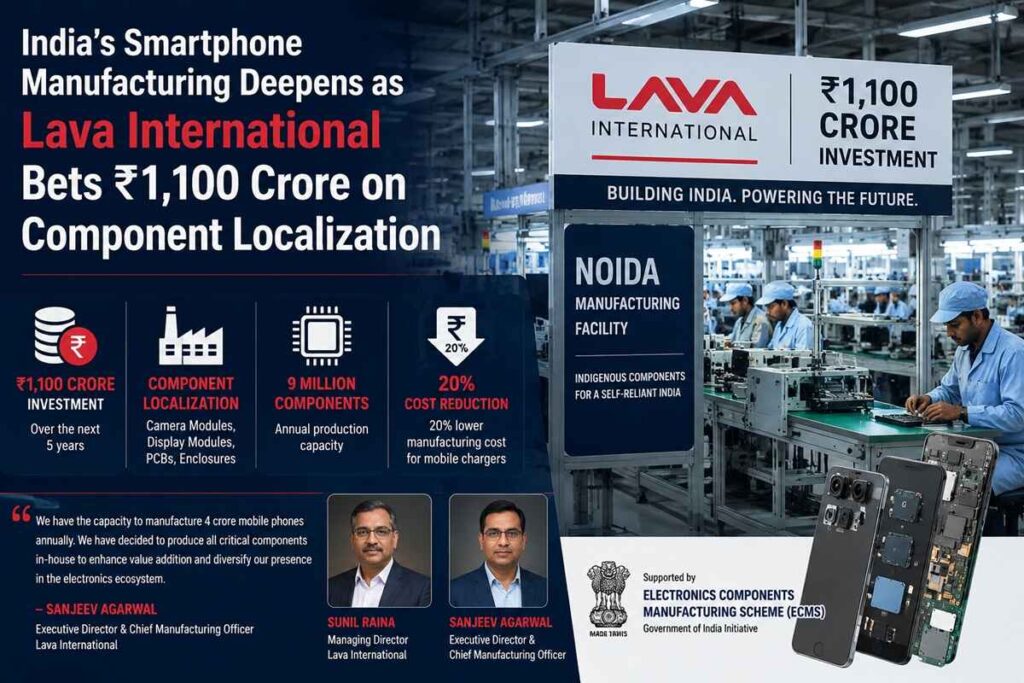

On Thursday, May 21, 2026, homegrown mobile handset manufacturer Lava International announced a major backward integration strategy, committing ₹1,100 crore over the next five years to manufacture critical electronic components domestically.
The announcement was made during the inauguration of Lava’s new mobile charger assembly line at its primary hub in Noida, Uttar Pradesh, by Sunil Kumar Sharma, the state’s Minister of Electronics & Information Technology.
Project Blueprint: Deepening the Component Ecosystem
Rather than just assembling imported sub-systems, Lava’s new investment is geared toward manufacturing complex component verticals in-house under the central government’s Electronics Components Manufacturing Scheme (ECMS).
- Total Capital Outlay: ₹1,100 crore distributed across a 5-year phase.
- Target Components: The funding will establish specialized manufacturing lines for camera modules, display modules, mechanical enclosures, and multi-layer printed circuit boards (PCBs).
- Capacity Targets: While Lava already maintains a massive baseline capacity to produce 4 crore (40 million) mobile phones annually, this specific component-focused expansion will initially build out an annual component production capacity of 9 million units.
Operational Impact: The Charger Localisation Case
To prove the fiscal viability of its localization push, Lava showcased its newly operational, designed-in-India mobile charger assembly line at the Noida site.
- Immediate Cost Reductions: By utilizing largely locally sourced components and proprietary in-house designs, Lava has managed to reduce the manufacturing cost of its chargers by approximately 20% compared to the third-party units it was previously procuring.
- Higher Domestic Value Addition: Moving charger production completely in-house serves as the initial test case for the brand’s larger component-level roadmap.
- Supply Chain De-risking: The overarching goal, as highlighted by Managing Director Sunil Raina, is to systematically insulate Lava from global component supply chain bottlenecks and volatile semiconductor logistics.
Strategic Rationale: Turning Assemblies into Fabrications
Lava’s pivot reflects a wider maturation among Indian original equipment manufacturers (OEMs). For years, Indian mobile manufacturers operated primarily as semi-knocked-down (SKD) assemblers.
By taking on front-end component manufacturing natively, Lava is substantially lifting its localized value-add percentages. This transition ensures that a larger share of the smartphone’s Bill of Materials (BOM) is spent, processed, and retained within the domestic economy.
“We have the capacity to manufacture 4 crore mobile phones annually. We have decided to produce all critical components in-house to enhance value addition and diversify our presence in the electronics ecosystem.” — Sanjeev Agarwal, Executive Director and Chief Manufacturing Officer, Lava International.
Disclaimer:
The information provided on this website is intended solely for general informational and educational purposes. Certain content may be generated using artificial intelligence and could contain inaccuracies or omissions; therefore, its accuracy, completeness, and reliability cannot be guaranteed. Any opinions or views expressed are those of the respective authors or sources and do not necessarily represent the official editorial position of this publication.


