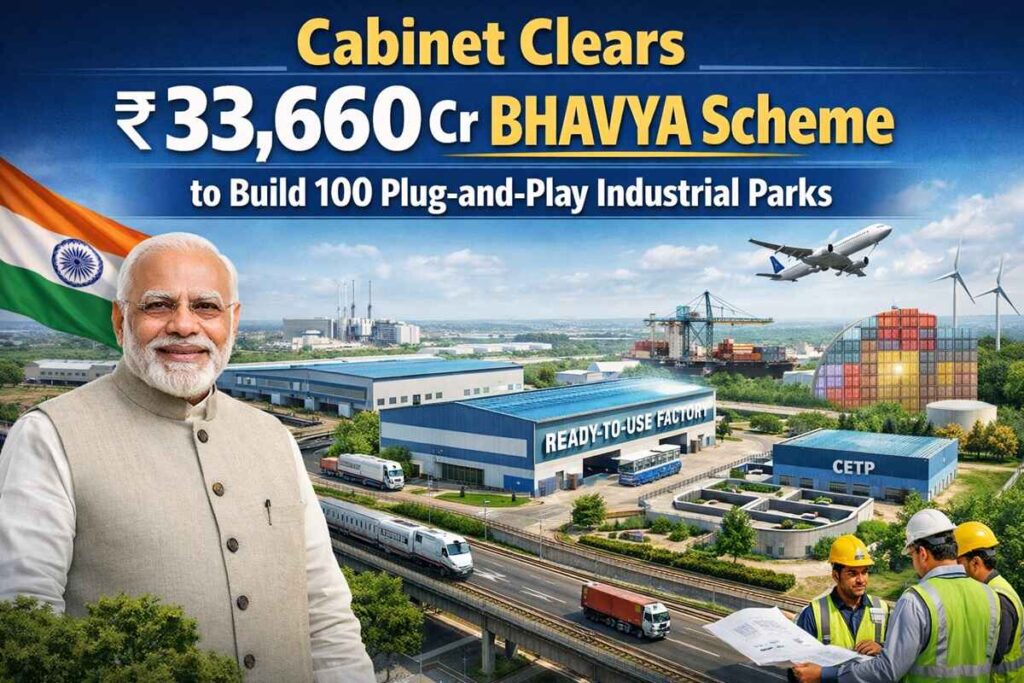

BHAVYA Scheme : On Thursday, March 19, 2026, the Union Cabinet approved a landmark industrial infrastructure scheme named Bharat Audyogik Vikas Yojna (BHAVYA). With a total outlay of ₹33,660 crore, the program is designed to establish 100 “plug-and-play” industrial parks across the country, effectively removing the “entry barriers” for both domestic MSMEs and global manufacturers.
Managed by the National Industrial Corridor Development Corporation (NICDC), BHAVYA represents the most aggressive push toward standardized, world-class manufacturing zones in India’s history.
The BHAVYA Scheme Blueprint: Standardizing Scale
The scheme focuses on speed-to-market by providing ready-to-use infrastructure so that companies can begin production within weeks of allotment, rather than years.
- Park Size: Ranging from 100 to 1,000 acres.
- Financial Support: The Union Government will provide ₹1 crore per acre for internal development.
- Core Infrastructure: Funding covers internal roads, underground utilities, drainage, and common effluent treatment plants (CETPs).
- Ready-Built Ecosystems: Support for pre-constructed factory sheds, built-to-suit (BTS) units, testing labs, and integrated warehousing.
- Worker Welfare: A dedicated portion of the fund is earmarked for on-site worker housing and employee amenities to support a “walk-to-work” culture.
- Connectivity: The government will fund up to 25% of external infrastructure costs, such as last-mile rail or highway connectivity.
Strategic Rationale: Cluster-Based Growth
BHAVYA Scheme moves away from isolated factories toward integrated clusters where manufacturers, tier-1/2 suppliers, and logistics providers operate in a shared ecosystem.
- Bureaucratic Decoupling: A centralized Single-Window System will handle all environmental, building, and operational clearances, drastically cutting lead times.
- Import Substitution: By creating specialized parks for rare earths, capital goods, and container manufacturing, India aims to plug critical gaps in its sovereign supply chain.
- The 7-Sector Focus: The scheme prioritizes Semiconductors, Biopharma, Electronics, Chemicals, Textiles, Renewable Energy, and Aerospace.
Macro-Economic Context (Union Budget 2026-27)
BHAVYA Scheme acts as the “physical foundation” for the massive fiscal incentives announced in the recent budget:
| Scheme / Mission | Budget 2026-27 Outlay | Synergy with BHAVYA |
| India Semiconductor Mission 2.0 | ₹40,000 Crore | Dedicated “Semi-Parks” with high-purity water/power. |
| Electronics Mfg. Incentives | ₹40,000 Crore | Plug-and-play sheds for rapid mobile/component assembly. |
| PLI Scheme (Existing) | ₹1.97 Lakh Crore | Scaling domestic capacity within the new 100 parks. |
| Container Manufacturing | New Initiative | Specialized parks near major ports (Mundra/JNPT). |
Impact on “Viksit Bharat 2047”
The BHAVYA scheme is expected to unlock ₹2.5 lakh crore in private investment over the next five years. By providing high-quality housing and amenities on-site, the government is also addressing the “labor migration” challenges that have historically hampered large-scale industrial output in India.
“BHAVYA is not just about roads and sheds; it is about creating a plug-and-play reality for global supply chains looking for a ‘China Plus One’ alternative with Indian reliability.” — Official Cabinet Briefing.
