
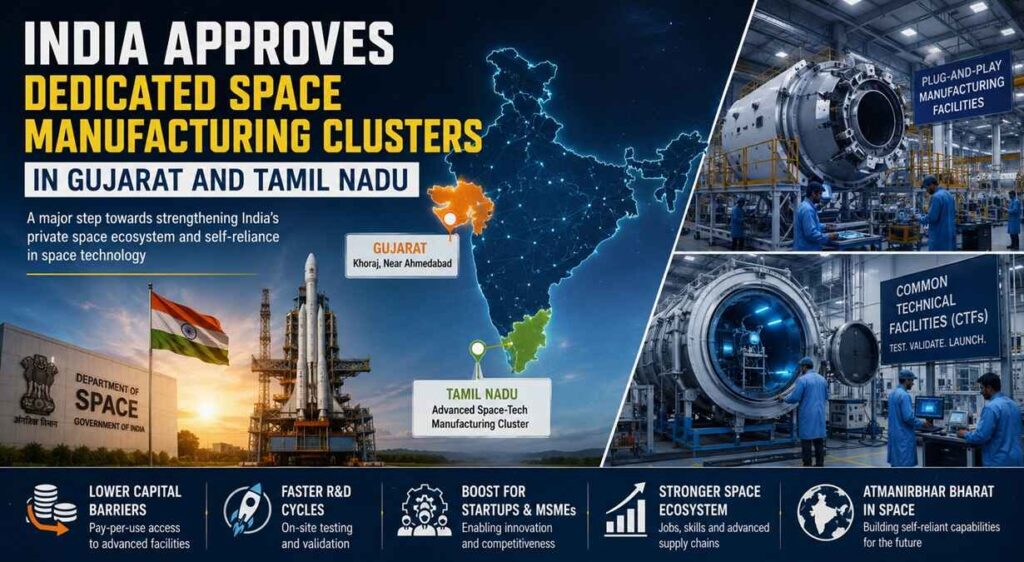

On Saturday, May 23, 2026, the Department of Space (DoS) authorized a two-pronged initiative to build dedicated space-technology manufacturing clusters and centralized testing infrastructures in Gujarat and Tamil Nadu.
This initiative introduces a shared-infrastructure model designed to radically lower capital barriers for Indian space startups, small and medium enterprises (MSMEs), and larger aerospace firms.
The Blueprint: Collaborative Manufacturing & Testing
The initiative splits responsibilities between state governments and the central space regulator to fast-track construction:
- State Responsibility: State governments are allocating large, contiguous land parcels optimized for heavy engineering and advanced logistics.
- IN-SPACe Responsibility: The Indian National Space Promotion and Authorization Centre (IN-SPACe) will procure, install, and run Common Technical Facilities (CTFs) inside these parks before handing operations back to the states.
The Gujarat Node: Khoraj ‘Plug-and-Play’ Cluster
Gujarat’s manufacturing hub is positioned to tap into existing high-tech industrial supply lines.
- Location: Khoraj, near Ahmedabad. The site was specifically chosen due to its proximity to the state’s major automotive, precision engineering, and newly established semiconductor corridors (like the Dholera fab ecosystem).
- Production Focus: The park is tailored for companies building complete spacecraft, complex payload systems, and down-link space applications.
- The Plug-and-Play Advantage: Startups can rent fully built modular manufacturing floors with immediate access to multi-million dollar testing machinery without needing to buy the equipment themselves.
The Economic Value of Common Technical Facilities (CTFs)
Building space hardware requires intensive specialized environmental verification before launch. Currently, around 40 private space tech startups utilize IN-SPACe’s base facilities in Ahmedabad. Expanding these into full CTFs solves a major growth bottleneck:
- Capital Preservation: High-vibration tables, thermal vacuum chambers (TVAC), and electromagnetic compatibility (EMC) chambers cost tens of crores to set up and maintain. CTFs allow private firms to use these systems on a pay-per-use basis.
- Accelerated R&D Timelines: Startups can manufacture and immediately run qualification tests on-site rather than transporting delicate hardware across the country to isolated ISRO centers.
Ahmedabad’s Emerging Space Ecosystem
According to local industry founders, Ahmedabad is organically morphing into India’s commercial space capital due to a unique concentration of institutional anchor points:
- SAC-ISRO: The Space Applications Centre (ISRO) provides a deep, localized talent pool of retired and active space engineers.
- Academic Anchors: The Physical Research Laboratory (PRL) and the Institute for Plasma Research (IPR) feed cutting-edge plasma, sensor, and material research directly into the private sector.
“The park equipped with curated state-of-the-art common facilities will be a strategic enabler for rapid growth of space tech manufacturing. It is a strategic enabler for the rapid growth of private aerospace fabrication.” — M K Das, Gujarat Chief Secretary.
Disclaimer:
The information provided on this website is intended solely for general informational and educational purposes. Certain content may be generated using artificial intelligence and could contain inaccuracies or omissions; therefore, its accuracy, completeness, and reliability cannot be guaranteed. Any opinions or views expressed are those of the respective authors or sources and do not necessarily represent the official editorial position of this publication.


