
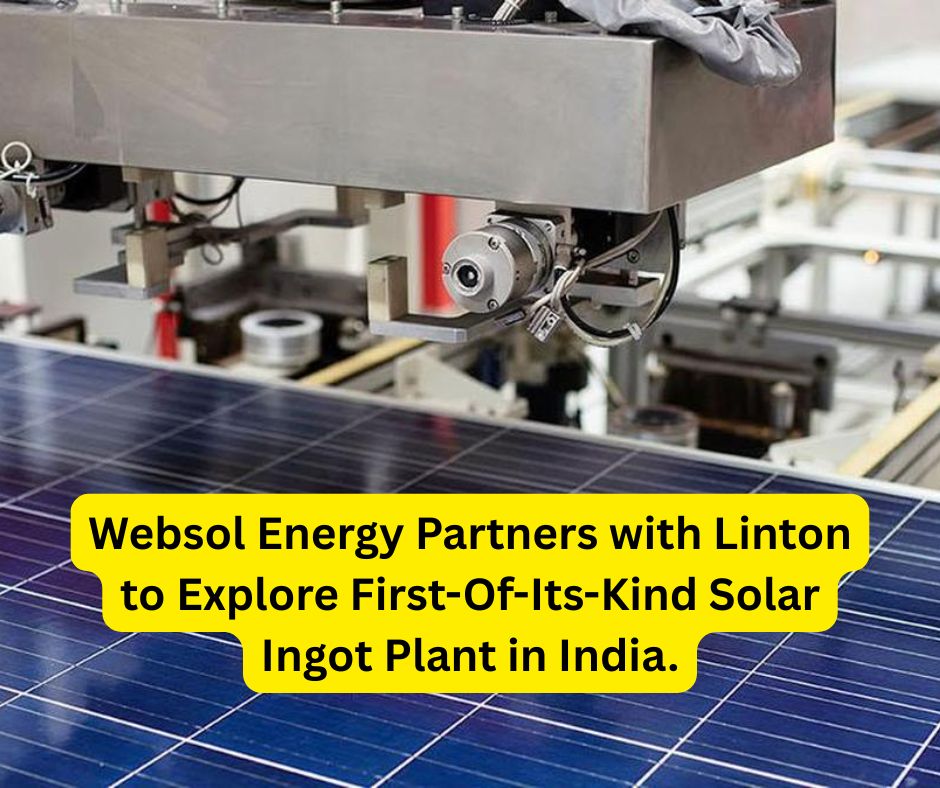
In a strategic move to reduce India’s reliance on imported solar components Kolkata-based Websol Energy System has signed an initial pact with U.S. technology leader Linton Crystal Technologies to explore setting up a Photovoltaic (PV) ingot and wafer manufacturing facility in India.
The companies have entered into a Memorandum of Understanding (MoU) to study the feasibility of this venture. The plan involves Websol acquiring specialized PV ingot and wafer manufacturing equipment from Linton, a global expert in the crystal-growing technology essential for making solar cells.
Building a Foundational Supply Chain
This potential partnership targets the very foundation of solar panel production. Ingots and wafers are the primary high-value raw materials from which solar cells are made. Currently, India’s massive solar sector depends heavily on imports, mainly from China for these critical components.
By exploring domestic manufacturing Websol aims to secure its supply chain and add significant technological depth to its operations. “We aim to reduce our dependence on key raw material imports and enhance the company’s technology base,” said Sohan Lal Agarwal, Managing Director of Websol Energy System. He highlighted Linton’s “global expertise” and “three decades of experience” as key reasons for the partnership.
A Step Toward Energy Security
Linton Crystal Technologies, headquartered in Rochester, New York, is a world leader in designing and building the sophisticated Czochralski (CZ) furnaces used to produce the high-purity silicon crystals required for efficient solar cells.
If realized, this facility would mark a major step forward in India’s Atmanirbhar Bharat (Self-Reliant India) mission for renewable energy. It would strengthen the domestic solar manufacturing ecosystem from the ground up, contributing directly to the nation’s long-term energy security and sustainability goals as it accelerates its solar power capacity.