
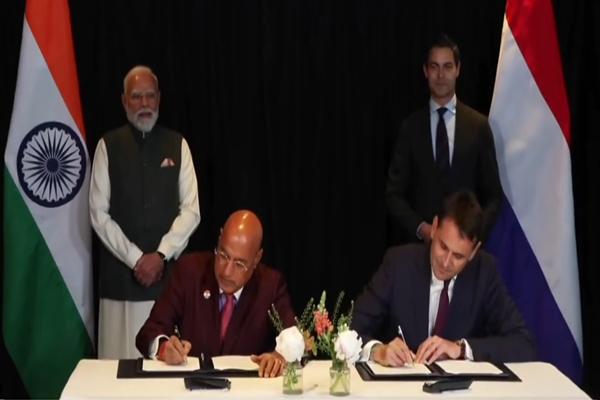
On Saturday, May 16, 2026, Tata Electronics and Dutch semiconductor manufacturing giant ASML signed a landmark Memorandum of Understanding (MoU) during Prime Minister Narendra Modi’s state visit to the Netherlands.
This partnership represents a monumental shift for India’s tech sovereignty. ASML holds an effective global monopoly on advanced lithography equipment—the highly complex machines that use light to print micro-thin circuit patterns onto silicon wafers. Securing their direct cooperation is a major validation of India’s multi-billion dollar push into front-end chip fabrication.
Project Blueprint: Powering the Dholera Megafab
The collaboration will center around the rapid deployment and optimization of ASML’s technology at Tata’s upcoming mega-project.
- The Target Facility: Tata Electronics’ $11 billion (approx. ₹91,000 crore) commercial 300 mm (12-inch) semiconductor fabrication plant in Dholera, Gujarat.
- The Technology Suite: ASML will deploy its “holistic suite” of advanced lithography tools, software, and metrology solutions to ensure the fab achieves high manufacturing yields quickly.
- Target Applications: Chips produced at this facility will serve high-growth global sectors including Artificial Intelligence (AI) computing, automotive systems, and mobile devices.
- Node Range: The equipment will support the node capabilities Tata is establishing via its foundational partnership with Taiwan’s PSMC, which spans technologies from 28nm down to 110nm.
Beyond Equipment: Building a Deep Ecosystem
A semiconductor fab cannot run on machinery alone; it requires a highly specialized local workforce and hyper-reliable component pipelines. The MoU outlines three long-term initiatives:
- Lithography Skill Development: ASML and Tata will co-develop specialized training programs to build a pipeline of local lithography experts—a highly specialized skill set currently rare in India.
- Supply Chain Resilience: The two giants will proactively collaborate to map out and nurture a domestic sub-tier supplier network for specialized parts and materials.
- Joint R&D Infrastructure: The partnership includes a shared commitment to building local research capabilities to ensure the Dholera fab can iterate and upgrade its processes natively over the coming decade.
Geopolitical Context: A Transatlantic Tech Bridge
The signing, witnessed by PM Modi and Dutch Prime Minister Rob Jetten in The Hague, highlights a calculated realignment of the global chip supply chain.
Faced with tightening Western export controls and geopolitical tensions in East Asia, European equipment makers like ASML are actively seeking geographical diversification. Simultaneously, India is positioning itself as the ultimate “China Plus One” alternative, aiming to elevate its domestic semiconductor sector to global parity by 2032.
“ASML’s deep expertise in holistic lithography solutions will ensure the timely ramp of our Fab in Dholera, create a resilient and trusted supply chain for our global customers, drive innovation, and develop talent locally.” — Dr. Randhir Thakur, CEO & MD, Tata Electronics.
Disclaimer:
The information provided on this website is intended solely for general informational and educational purposes. Certain content may be generated using artificial intelligence and could contain inaccuracies or omissions; therefore, its accuracy, completeness, and reliability cannot be guaranteed. Any opinions or views expressed are those of the respective authors or sources and do not necessarily represent the official editorial position of this publication.