
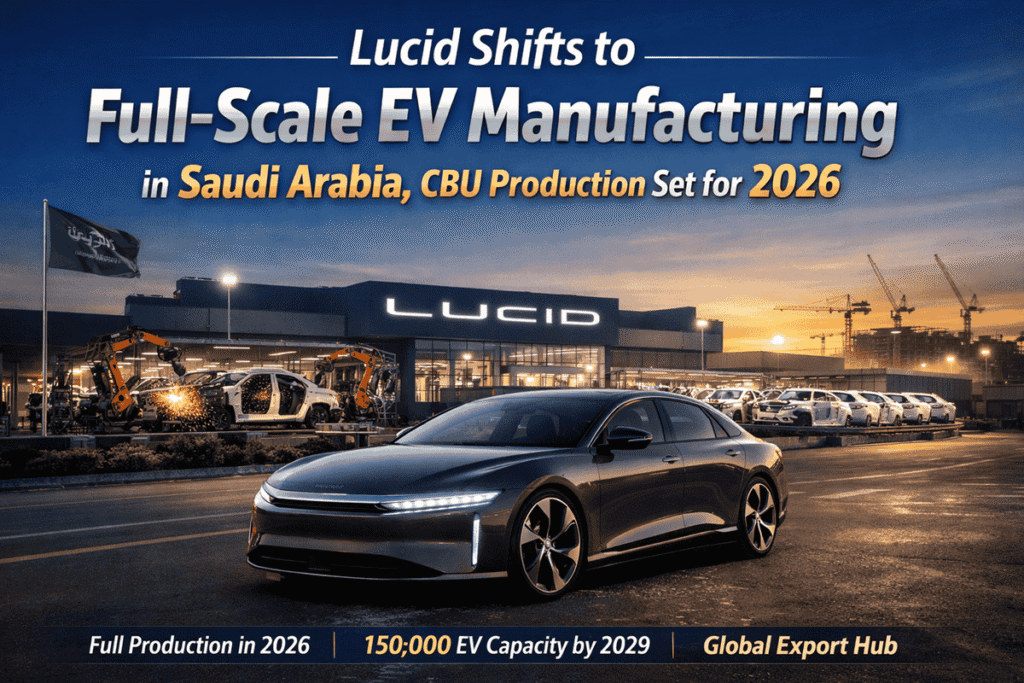
Lucid Group is indeed moving into a major new phase in Saudi Arabia this year. While the company has been re-assembling cars in the Kingdom since late 2023, 2026 marks the transition to full-scale, integrated manufacturing.
As of mid-January 2026, here is the current status of Lucid’s Saudi operations:
The Shift to Full Manufacturing (AMP-2)
Since September 2023, Lucid’s AMP-2 (Advanced Manufacturing Plant 2) in King Abdullah Economic City (KAEC) has operated as a “semi-knocked-down” (SKD) facility. Essentially, cars were fully built in Arizona, disassembled, shipped, and then put back together in Saudi Arabia.
What changes in 2026:
- Complete Build Unit (CBU) Production: Lucid is on track to transition from simple re-assembly to full-scale manufacturing (CBU) by the end of 2026.
- Infrastructure Ready: As of early 2026, the company has completed construction of approximately eight buildings at the site to support integrated production, including body and paint shops.
- Equipment Move: In January 2026, Lucid’s interim CEO Marc Winterhoff confirmed that the company has already begun moving specialized manufacturing equipment into the new facility.
Production & Capacity Roadmap
- Current Output: The assembly plant has reached a milestone of over 1,000 vehicles assembled in Saudi Arabia as of late 2025.
- 2026 Goal: Full-scale production is expected to begin toward the end of 2026.
- Future Target: The plant is designed to eventually reach an annual capacity of 150,000 to 155,000 vehicles by 2029.
Strategic Importance
- Export Hub: Saudi-built Lucid vehicles are now being exported to the UAE, and the company plans to use the expanded 2026 facility as a global export hub for Europe and the wider Middle East.
- Tariff Shield: Manufacturing in Saudi Arabia allows Lucid to import certain materials from China for their next-generation midsize platform without incurring the heavy duties imposed on US-made imports.
- Vision 2030: The project remains the flagship of Saudi Arabia’s goal to produce 500,000 EVs annually by 2030, supported by over $8 billion in investment from the Public Investment Fund (PIF).