
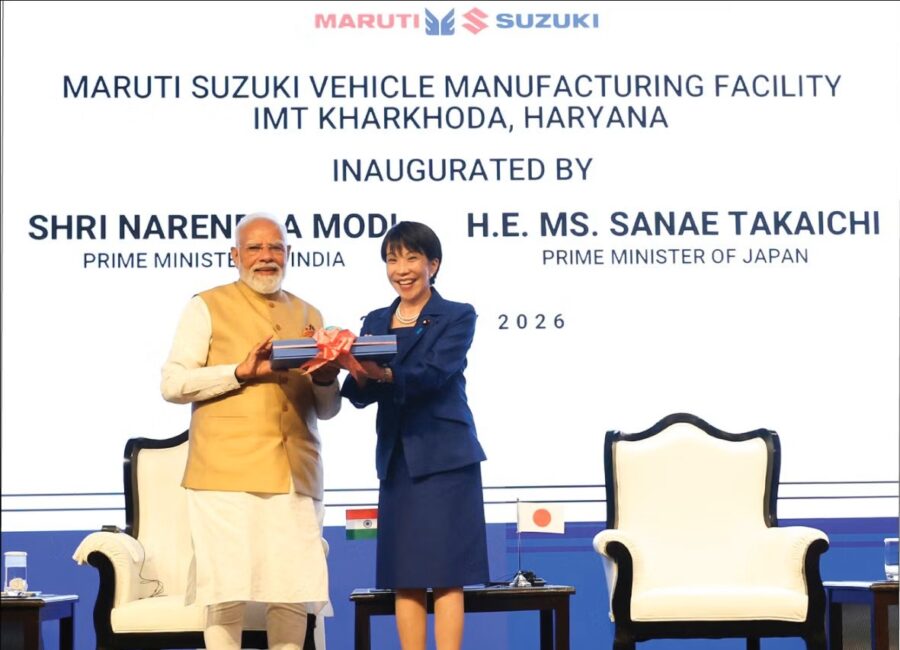
The landscape of Indian automotive manufacturing changed on July 2, 2026. At the India-Japan Joint Economic Forum in New Delhi, Prime Minister Narendra Modi and Japanese Prime Minister Sanae Takaichi virtually inaugurated Maruti Suzuki’s massive, state-of-the-art vehicle production facility at IMT Kharkhoda in Haryana.
Spanning 800 acres, this project represents a monumental ₹35,000 crore investment. With an initial annual production capacity of 5 lakh (500,000) units—and plans to scale up to 10 lakh units—the Kharkhoda mega-complex is set to become one of the largest automobile manufacturing plants in the world.
The Strategic Importance & Industry Impact of Automotive News
In the fast-moving digital age, major industrial news updates like this do more than fill headlines. Breaking auto-sector news serves as a massive catalyst for economic confidence and ecosystem growth across the continent.
- The Power of News in Driving Industry Trends: Industrial announcements serve as market signals. When a market leader like Maruti Suzuki makes a decisive move toward green infrastructure and Industry 5.0, it sets a brand-new baseline for the entire domestic supply chain, forcing a collective shift toward advanced technology.
- Organizational Capacity Impact: News of this scale directly boosts Maruti Suzuki’s internal operational efficiency and supply-chain readiness. The project includes an integrated supplier park right on site. Component manufacturers will operate right next to the main factory. This eliminates logistically painful, multi-state shipping delays, allowing for rapid-response manufacturing cycles.
- Market Dynamics and Consumer Sentiment: Massive capital expenditure updates send a reassuring wave through the stock market and consumer bases alike. It signals long-term stability, reinforces brand trust, and guarantees a steady supply of new vehicles to dealerships—effectively reducing lengthy waiting periods for customers.
Inside the Suzuki Smart Factory: Industry 5.0 and Green Tech
The Kharkhoda facility is built around the modern Suzuki Smart Factory concept, leaning heavily on automated precision, data integration, and aggressive eco-friendly parameters.
Instead of traditional heavy robotics operating in isolated cages, the assembly lines utilize human-aware collaborative robots (cobots) designed to assist workers directly, prioritizing ergonomics and physical safety. Real-time digital monitoring tracking ensures that build anomalies are caught instantly.
The dedicated, in-plant railway siding stands out as a logistical game-changer. Rather than relying entirely on thousands of diesel carrier trucks clogging India’s national highways, finished passenger cars will roll directly onto trains, driving down transport emissions.
Market Landscape: Maruti Suzuki vs. Key Competitors
As Maruti Suzuki pushes its absolute manufacturing capabilities forward, it widens the production gap between itself and its closest market rivals, Hyundai and Tata Motors.
| Metric | Maruti Suzuki India | Hyundai Motor India | Tata Motors (PV Division) |
| Projected Network Capacity | ~29 Lakh Units (By FY26-27 across 4 hubs) | ~8.5 Lakh Units (Targeting 10 Lakh via Talegaon expansion) | ~10 Lakh Units (Including Sanand TPG facility) |
| Primary Automation Push | Industry 5.0 Cobots & Integrated Supplier Parks | Advanced robotic stamping & global smart logistics | Connected factory platforms & dedicated EV architectures |
| Export Status / Strategy | Exclusive global hub for e Vitara SUV; shipping to 100+ nations | Robust export footprint to Africa, Middle East, and Latin America | Domestic-focused growth; gradual EV exports to emerging markets |
While Hyundai relies heavily on its hyper-efficient Chennai operations and its newly acquired Talegaon plant to break the million-unit threshold, and Tata Motors focuses on its multi-fuel vehicle architectures across Sanand and Pune, Maruti Suzuki is leveraging raw volume, localized component ecosystems, and deep bilateral India-Japan economic support to cement a dominant market share.
The Global Blueprint: “Make in India, Make for the World”
India is no longer just a regional outpost for Suzuki Motor Corporation; it is the nucleus of its global operations. During the forum, Suzuki President Toshihiro Suzuki highlighted that two-thirds of Suzuki’s global production is now rooted in India.
Vehicles rolling off Indian assembly lines have made Suzuki the single largest automobile importer into Japan. Furthermore, Maruti’s first battery-electric SUV, the e Vitara, is manufactured exclusively in India for shipping to nearly 100 global markets. By scaling up massive industrial townships like Kharkhoda and investing in human capital through its Japan-India Institutes for Manufacturing (JIM), Maruti Suzuki is transforming the nation’s automotive goals from a localized consumption market into an aggressive, green-reliant export powerhouse.