
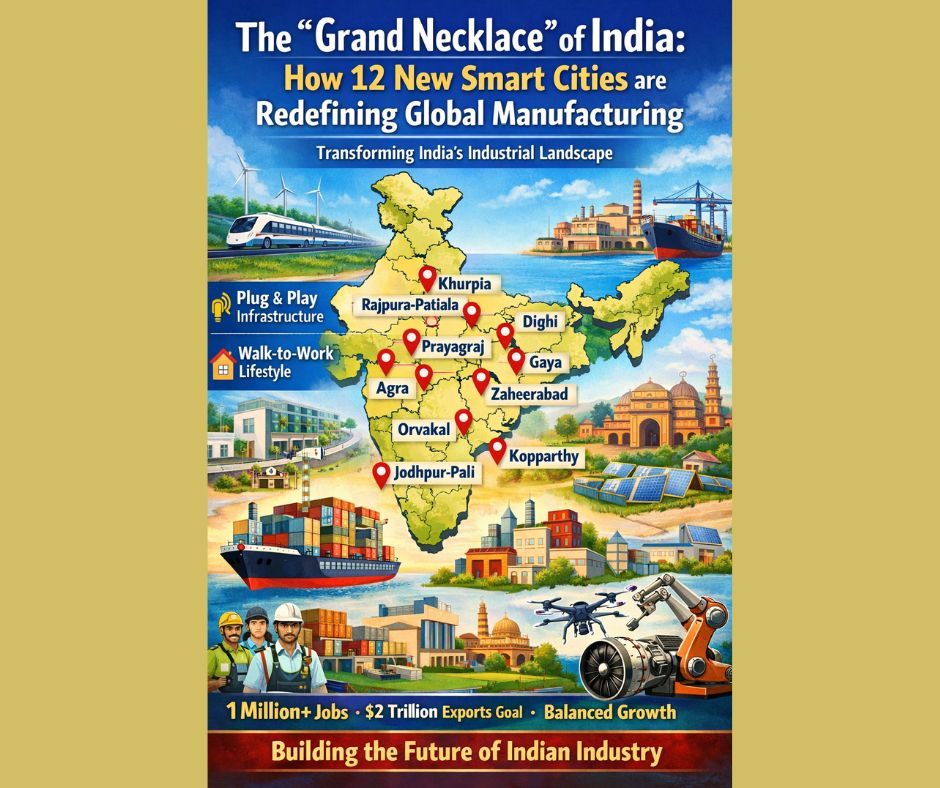

For decades, India’s industrial landscape was a tale of a few concentrated hubs, leaving vast regions in the shadow of development. This concentration led to a “metro-stress” phenomenon—overburdened infrastructure in cities like Mumbai and Bengaluru, while potential talent in Tier-II regions remained untapped.
To break this cycle the Government of India has launched its most ambitious urban-industrial blueprint yet: the National Industrial Corridor Development Programme (NICDP). With a ₹28,602 crore investment the government is building 12 greenfield industrial smart cities “ahead of demand.” This is not just a construction project; it is a strategic maneuver to position India as a premier destination in Global Value Chains (GVC).
The Strategy: “Plug-and-Play” & “Walk-to-Work”
Unlike traditional industrial zones, these 12 cities are designed as integrated ecosystems. They operate on two revolutionary concepts:
- Plug-and-Play: Investors don’t have to worry about power, water, or clearances. Everything from high-speed internet to effluent treatment is ready before the first factory brick is laid.
- Walk-to-Work: By integrating residential and commercial zones within the industrial clusters, these cities aim to eliminate the long commutes that plague modern urban life, fostering a sustainable, high-quality lifestyle for the workforce.
A Deep Dive: The 12 Industrial Powerhouses
These cities are strategically distributed across 10 states and 6 major corridors to ensure balanced regional growth.
| City & State | Focus Sectors | Key Highlights |
| Khurpia, Uttarakhand | Auto & Engineering | 1,002 acres; transforming agricultural land into a modern manufacturing hub near Kiccha. |
| Rajpura-Patiala, Punjab | Electronics, Pharma, Textiles | 1,100 acres; designed as the “Gateway of Punjab” with a heavy focus on high-tech manufacturing. |
| Dighi, Maharashtra | Engineering, Pharma, Chemicals | A massive 6,056-acre port-led development aiming for a ₹38,000 crore total impact. |
| Palakkad, Kerala | Hi-tech Mfg, Medical, Logistics | 1,710 acres near NH 544; a critical node for the Kochi-Bengaluru Corridor. |
| Agra, Uttar Pradesh | Leather, Footwear, Agro-based | 1,050 acres focusing on non-polluting industries near heritage sites. |
| Prayagraj, Uttar Pradesh | E-mobility, Garments, Packaging | 352 acres at Saraswati Hi-Tech city with elite multimodal connectivity. |
| Gaya, Bihar | Agro, Textile, Engineering | 1,670 acres near Dhobi; a major innovation hub for the Eastern corridor. |
| Zaheerabad, Telangana | Automobiles & Manufacturing | A sprawling 12,635 acres; Hyundai is already eyeing a 450-acre auto hub here. |
| Orvakal, Andhra Pradesh | India’s First Drone City | 9,719 acres focusing on aerospace, defense, and renewable energy. |
| Kopparthy, Andhra Pradesh | Electronics & Maritime Trade | 6,740 acres; strategic proximity to Kadapa Airport and major ports. |
| Jodhpur-Pali, Rajasthan | Self-sustained Township | 3,600 hectares; poised to be the largest industrial area in the state. |
Why This Matters: The Economic Ripple Effect
The NICDP is more than just “land and buildings.” It is a catalyst for three major shifts:
- Employment Revolution: The program is projected to create 1 million direct jobs and nearly 3 million indirect jobs, providing a massive boost to the national employment rate.
- Export Ambition: These nodes are designed to help India reach its goal of $2 trillion in exports by 2030. By reducing logistics costs (currently 13-14% of GDP) to roughly 9%, Indian goods will become significantly more competitive globally.
- Regional De-risking: By spreading manufacturing across states like Bihar, Uttarakhand, and Kerala, the government is ensuring that a disruption in one region doesn’t stall the national economy.
Expert Analysis: Moving Beyond “Assembly”
Historically, India has been an assembly point. The NICDP changes the narrative to Precision Manufacturing. With dedicated clusters for medical devices in Palakkad and aerospace in Orvakal, India is moving up the value chain. This infrastructure “ahead of demand” ensures that when a global giant like Tesla or Apple looks to expand, India doesn’t just offer labor; it offers a world-class, ready-to-move-in ecosystem.


