
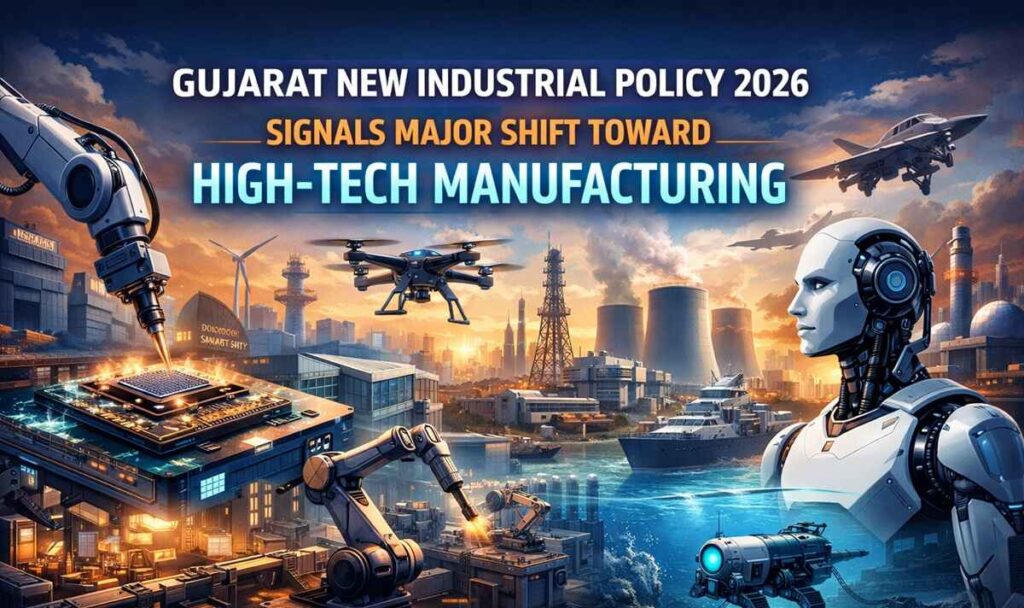
Gujarat is on the verge of unveiling its Gujarat New Industrial Policy 2026 a roadmap designed to transform the state from a traditional manufacturing base into a global center for new-age technologies.
This policy represents a strategic pivot reintroducing direct financial support for large-scale industries while aggressively courting sectors that will define the next decade of global trade.
Why This News Matters
For the first time in several years, Gujarat is shifting its strategy to compete with “peer states” (like Tamil Nadu and Karnataka) by reintroducing capital subsidies for large projects. This move acknowledges that while Gujarat has the best infrastructure, financial incentives are now the “deal-breaker” for global giants in high-tech fields.
Furthermore, the relaxation of local employment norms from 85% to 50% for aerospace and defense is a pragmatic “talent-first” move. It allows companies to hire specialized engineers from across India, making it easier to set up complex R&D centers in the state.
New “Thrust Sectors” for 2026
The policy expands the definition of “Thrust Sectors” to include industries that are currently in their infancy but have massive growth potential:
- Semiconductor Ancillaries: Focused on the chemicals, gases, and specialized tools needed for the fabs already coming up in Dholera.
- Robotics & Drones: Positioned to support both industrial automation and defense applications.
- Nuclear Power Equipment: Tapping into India’s push for clean energy through small modular reactors (SMRs).
- Sports Goods: A forward-looking move as Gujarat prepares to host the 2030 Commonwealth Games and bids for the 2036 Olympics.
- The Blue Economy: Focusing on sustainable deep-sea mining and maritime technology.
Gujarat New Industrial Policy 2026 Key Policy Highlights at a Glance
| Feature | Proposed Change | Impact |
| Capital Subsidy | Up to 20% of Fixed Capital Investment (FCI). | Lowers the entry barrier for massive manufacturing plants. |
| Mega Projects | Custom packages for investments >₹2,500 Crore. | Attracts “Anchor” tenants who bring entire supply chains with them. |
| Local Hiring | Mandatory domicile quota cut from 85% to 50%. | Solves the skilled labor shortage for high-tech aerospace firms. |
| Sustainability | New incentives for e-waste and textile recycling. | Aligns Gujarat with global “Circular Economy” standards. |
Strategic Context: The “Aatmanirbhar” Link
The policy is designed to work in tandem with the Central Government’s Electronics Component Manufacturing Scheme (ECMS) and the India Semiconductor Mission. By offering state-level subsidies on top of central PLIs (Production Linked Incentives), Gujarat is aiming to become the lowest-cost destination for high-tech manufacturing in Asia.