
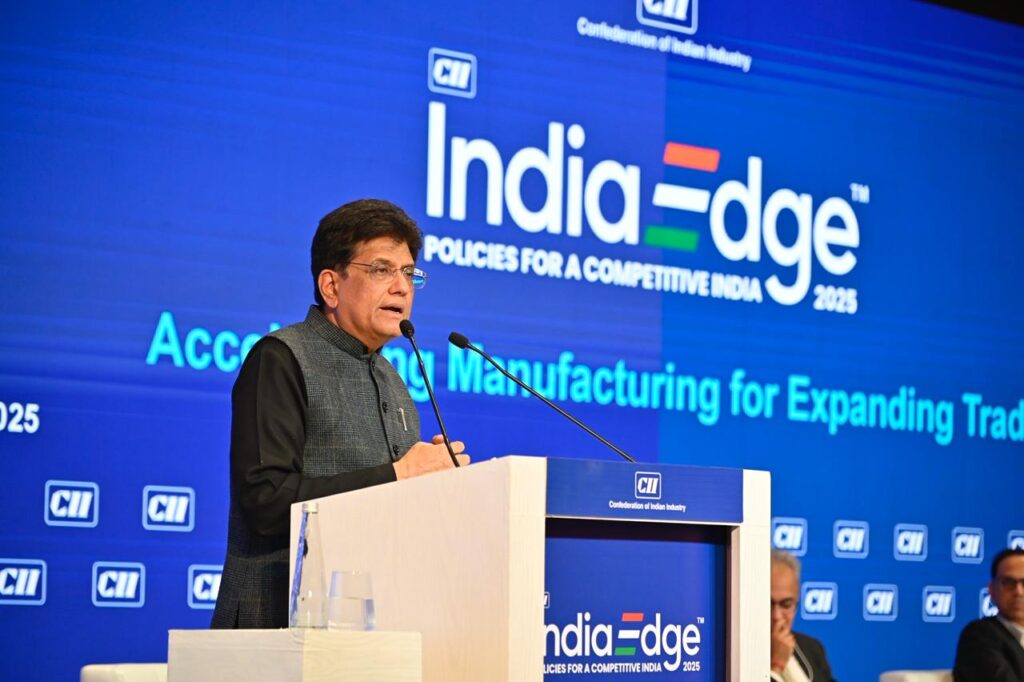

Union Minister of Commerce and Industry Piyush Goyal outlined a clear roadmap for India’s manufacturing future at the CII IndiaEdge event in New Delhi, emphasising innovation, quality and resilient supply chains as essential drivers to boost the country’s global competitiveness.
Speaking on Wednesday Goyal highlighted the government’s commitment to economic progress under Prime Minister Narendra Modi’s leadership noting significant diversification in India’s manufacturing output into new sectors like electronics, white goods, chemicals, and petrochemicals.
Building Resilient, Self-Reliant Supply Chains
A key focus of his address was the urgent need for supply chain resilience. Goyal cautioned against over-dependence on specific geographies—a lesson reinforced by recent global disruptions—and stressed the importance of building greater domestic capacity in critical areas. “We must identify where domestic capacity and greater control over supply chains are essential,” he stated.
Collaboration, Competitiveness and Ease of Doing Business
The Minister called for strong industry collaboration to expand manufacturing, which he said would further accelerate growth in the services sector. He also emphasised maintaining a competitive domestic market even as India strengthens its global footprint.
Goyal pointed to the rapid progress of states like Uttar Pradesh and Odisha, which has created more local opportunities and reduced migration. He invited industry suggestions to simplify procedures, improve regulatory systems, and strengthen the overall manufacturing environment.
Highlighting ongoing reforms, he noted efforts to ease compliance, remove obsolete laws, and modernise frameworks like the four Labour Codes which 23 states have already adopted. These codes aim to enhance formalisation, ensure minimum wages, and strengthen social security and workplace safety.
Supporting MSMEs and the Vision for a Developed India.
In a significant directive, Goyal underscored the importance of timely payments to MSMEs stating that prompt clearance of dues would ease cash flow constraints and boost their productivity and growth.
Reaffirming the national focus on Swadeshi and self-reliance the Minister linked these principles to strengthening domestic manufacturing. He concluded by asserting that the collective efforts of industry and government are crucial to realising the vision of an Atmanirbhar Bharat (Self-Reliant India) and achieving the national goal of Viksit Bharat (Developed India) by 2047.


