
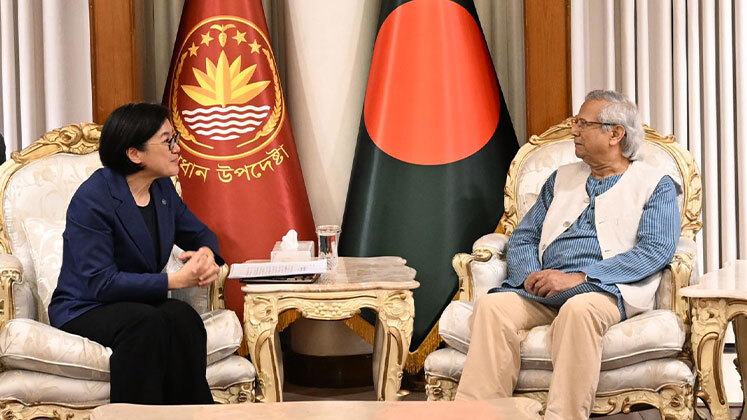
China is signaling a major shift in its investment strategy in Bangladesh moving away from its traditional focus on large infrastructure projects toward the country’s manufacturing sector. This renewed push highlights a strong interest from senior Chinese financial officials and investors in green technology, jute, textiles and pharmaceuticals, aligning with the “manufacturing revolution” championed by Bangladesh’s Chief Adviser, Professor Muhammad Yunus.
The change in direction was underscored during recent discussions between Professor Yunus and Yang Dongning, Vice-President of the Export-Import Bank of China (Exim Bank), at the State Guest House Jamuna. Ms. Yang, accompanied by Dr. Ma Jun, President of the state-run Institute of Finance and Sustainability, indicated that Chinese investors are increasingly drawn to high-value industrial ventures rather than simply large-scale construction.
Focus on Jute and Sustainable Technology
A key area of interest is Bangladesh’s traditional but promising jute industry. Ms. Yang detailed that China is actively exploring large-scale investments here, including projects that involve creating biofertilisers ,generating energy from jute by-products and developing biodegradable alternatives to plastic. Furthermore Exim Bank is prepared to finance the local production of rooftop solar panels reflecting a commitment to sustainable, green technology. Both Exim Bank and Chinese companies have expressed readiness to provide direct industrial investment to support these sectoral shifts.
Dr. Ma Jun reinforced this interest noting that Chinese firms actively seeking joint ventures have shown “strong interest” in collaborating within the jute sector.
Yunus’s Vision: An Export-Driven Hub
Chief Adviser Yunus warmly welcomed the pivot toward manufacturing seeing it as a critical step that could help position Bangladesh as a globally recognized, export-driven industrial hub.
He stressed that with support from the world’s second-largest economy Bangladesh could “go full speed” in sectors like healthcare and pharmaceuticals. Recognizing China’s global leadership in the field he particularly encouraged significant Chinese investment in solar energy.
Professor Yunus further advocated for Chinese companies to relocate their manufacturing facilities to Bangladesh. He pointed to the country’s significant strategic assets, including a large youth workforce and the immediate opportunity to repurpose idle state-run jute mills. Beyond traditional industries, he also extended an invitation for Chinese technology firms to explore the growing opportunities in e-commerce and artificial intelligence (AI) within the country.
The Call for Regional Connectivity
To fully realize the potential of relocated factories and expanded trade Professor Yunus also called for enhanced regional connectivity. He specifically proposed the development of new rail links connecting Bangladesh directly with southern China a move that would facilitate exports and strengthen key trade routes across Southeast Asia.