
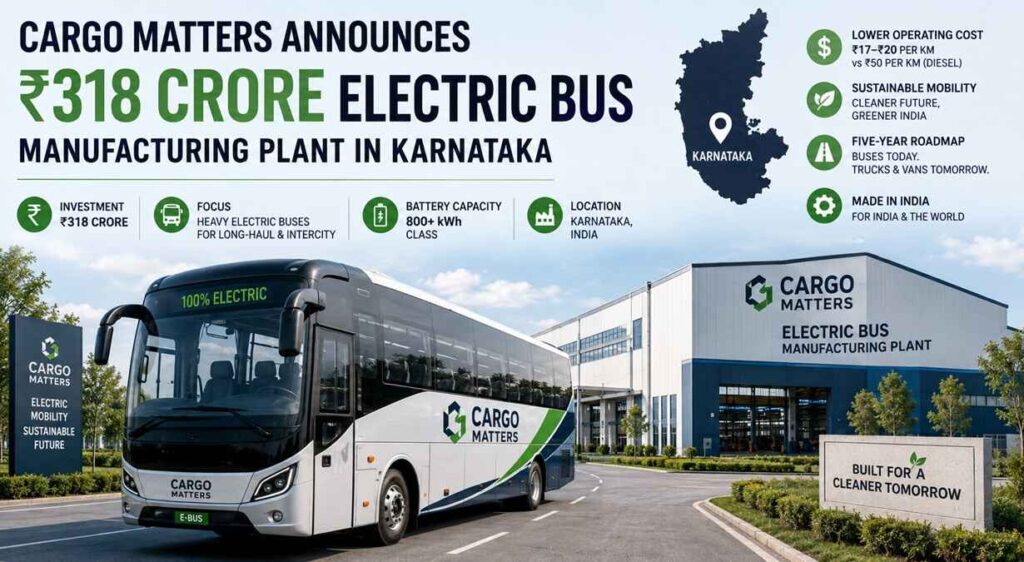

On Tuesday, May 19, 2026, international logistics and electric mobility enterprise Cargo Matters announced a major expansion into India’s clean commercial vehicle sector with an investment of ₹318 crore to set up an electric bus manufacturing facility in Karnataka.
The move establishes a critical production base in India for Cargo Matters, adding to its operational footprint across the United Kingdom, Bulgaria, and Australia, and marks a major push into high-capacity electric mass transit.
Project Blueprint: The Karnataka EV Plant
The upcoming manufacturing plant is designed to build heavy-duty commercial EVs tailored for demanding intercity and long-haul conditions.
- Initial Capital Outlay: ₹318 crore dedicated to production lines, assembly infrastructure, and advanced battery integration modules.
- Initial Product Focus: Heavy electric buses engineered specifically for long-distance, intercity passenger routes.
- Battery Architecture: The vehicles will feature massive battery packs exceeding 800 kWh—putting their energy storage and performance metrics in the same class as the Tesla Semi.
- Five-Year Pipeline: The facility forms the bedrock of an integrated EV roadmap that will scale up to include long-haul electric trucks and urban delivery vans within the next five years.
The Economic Disruptor: Targeting the “Volvo Benchmark”
The core strategic advantage of Cargo Matters’ platform lies in a massive reduction of total cost of ownership (TCO) for commercial fleet operators:
- Transformational Operational Savings: Cargo Matters estimates the operating costs of its electric buses at ₹17 to ₹20 per kilometer.
- The Diesel Contrast: In comparison, legacy diesel-powered premium buses from international manufacturers like Volvo cost nearly ₹50 per kilometer to operate under similar conditions.
- Captive Logistics Integration: Beyond selling to external transit authorities and private operators, Cargo Matters plans to deploy these high-capacity vehicles directly into its own global freight network.
- B2B Logistics Pitch: The company is positioning its upcoming heavy-duty electric trucks to target high-volume domestic logistics giants, such as Delhivery, to help them hit their corporate net-zero targets.
Strategic Rationale: Why Karnataka?
By choosing Karnataka, Cargo Matters taps into one of India’s most mature clean mobility ecosystems.
- Policy Support: The project benefits from Karnataka’s highly progressive Electric Vehicle & Energy Storage Policy, which offers capital subsidies, land concessions, and power tariff exemptions for mega-scale EV manufacturing units.
- Supply Chain Sophistication: The state (particularly around the Bengaluru-Hosur industrial belt) hosts a deep concentration of aerospace, precision electronics, and automotive engineering talent, vital for configuring complex 800+ kWh battery management systems (BMS).
- Charging Corridor Potential: Karnataka has been aggressively installing high-capacity fast-charging infrastructure along its major intercity highways, creating immediate operational viability for long-range electric buses rolling off the factory line.
“The market needs this. When you benchmark against Volvo, the operational cost advantage is not marginal — it is transformational.” — Cargo Matters Spokesperson.


