
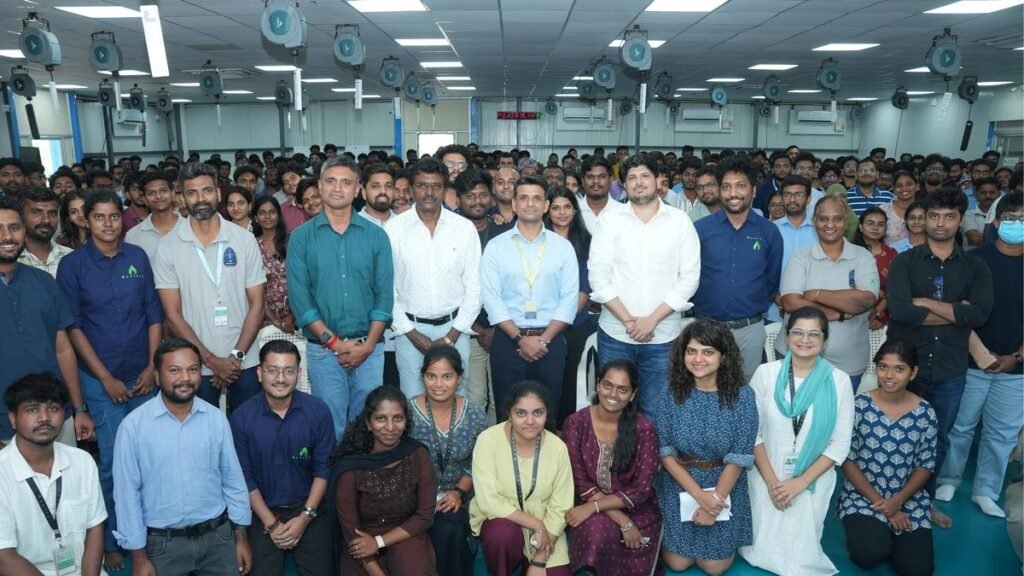

Chennai: Indian spacetech startup Agnikul Cosmos has strengthened its rocket manufacturing and testing capabilities with the inauguration of two new specialised facilities at its Assembly & Testing Facility in Chennai.
The newly commissioned units — the Stage Testing & Inspection Facility (STIF) and the Pressurant Tank Realization, Over-wrapping and Outfitting Facility (PROOF) — are aimed at increasing Agnikul’s in-house capabilities across rocket-stage testing, recovery, inspection and pressure-vessel manufacturing.
The expansion is particularly significant as the company works towards developing launch systems with greater reusability and end-to-end manufacturing control.
Two New Facilities Strengthen Agnikul’s Rocket Development Ecosystem
The two facilities address different but closely connected requirements in the development and operation of advanced launch vehicles.
| Facility | Primary capability | Key specification |
|---|---|---|
| STIF | Rocket-stage testing, inspection and requalification | Flight-like operating conditions |
| PROOF | In-house pressure-vessel manufacturing | More than 10 vessels/month |
| PROOF vessel capacity | Large pressure vessels | Up to 3,500 litres and 350 bar |
| Location | Agnikul Assembly & Testing Facility | Chennai, Tamil Nadu |
STIF: Testing Rocket Stages Under Flight-Like Conditions
The Stage Testing & Inspection Facility (STIF) has been established as a fully in-house facility for testing reusable rocket stages under conditions designed to replicate the demands of an actual flight.
The facility is intended to allow Agnikul to evaluate complete stages over the duration of their mission profile rather than limiting testing to individual components.
Sumadhura Group to Invest ₹400 Crore in New 52-Acre Logistics Park in Chennai.
An important feature is its ability to support post-flight inspection and requalification of recovered stages.
This capability is central to reusable launch technology. Instead of treating every launch vehicle stage as a single-use component, the ability to test, recover, inspect and prepare hardware for another mission can potentially improve launch economics and operational efficiency.
PROOF Brings Pressure-Vessel Manufacturing In-House
The second facility, PROOF, focuses on the manufacturing of pressure vessels used in rocket systems.
Pressure vessels are engineered components designed to contain gases or liquids at pressures substantially different from the surrounding environment. They can therefore play an important role in propulsion and other spacecraft systems where pressurised fluids or gases need to be safely stored and managed.
According to the company, PROOF can manufacture more than 10 pressure vessels per month, including vessels with capacities of up to 3,500 litres and pressure ratings of up to 350 bar.
Bringing this capability in-house can give Agnikul greater control over manufacturing quality, inspection, production timelines and component integration.
Reusability Becomes a Major Focus
Agnikul Cosmos Co-founder and CEO Srinath Ravichandran said the company’s approach to reusable launch technology requires capabilities that extend beyond a single mission.
The STIF is designed to support the complete cycle of testing, recovery, inspection and requalification, while PROOF strengthens the company’s move towards greater end-to-end control over critical rocket components.
Together, the two facilities represent an important shift from simply assembling launch vehicles towards building a broader in-house space manufacturing and qualification ecosystem.
Group Captain Shubhanshu Shukla Inaugurates Facilities
The new facilities were inaugurated by Group Captain Shubhanshu Shukla, Indian astronaut and a prominent figure in India’s human spaceflight programme.
Shukla highlighted the rapid development of advanced space capabilities across India and said it was encouraging to see Agnikul continue expanding its capabilities in advanced manufacturing and testing.
His presence at the inauguration also reflects the growing connection between India’s emerging private space industry and the country’s broader ambitions for increasingly sophisticated space missions.
Chennai Emerging as a Private Space-Technology Hub
Agnikul’s latest expansion further strengthens Chennai’s position in India’s growing private aerospace and spacetech ecosystem.
Advanced rocket development requires a wide network of specialised capabilities, including:
- Precision engineering
- Propulsion-system manufacturing
- Pressure-vessel production
- Non-destructive testing and inspection
- Aerospace-grade materials
- Electronics and avionics
- Additive manufacturing
- Quality assurance and certification
- Assembly and integration
- Launch and mission-support infrastructure
Facilities such as STIF and PROOF can help build these capabilities within India and reduce dependence on external suppliers for critical hardware.
Potential Impact on Jobs and Aerospace Supply Chains
The company has not disclosed a specific employment figure associated with the two newly inaugurated facilities. However, expansion of specialised rocket manufacturing and testing infrastructure typically creates demand for skilled engineers, technicians, quality professionals, manufacturing specialists and aerospace supply-chain partners.
The wider impact can extend beyond direct employment.
As India’s commercial space sector expands, demand is expected to grow for suppliers involved in precision machining, advanced materials, welding, composites, electronics, instrumentation, testing and other specialised aerospace manufacturing activities.
This could provide additional opportunities for Indian MSMEs and engineering companies to become part of the country’s emerging private-space supply chain.
Strengthening India’s Private Space Manufacturing Capabilities
Agnikul Cosmos’ latest facilities come at a time when India’s space sector is moving beyond traditional government-led programmes towards a broader ecosystem involving private launch companies, satellite manufacturers, component suppliers and technology startups.
For companies developing reusable launch systems, the ability to control critical manufacturing and testing processes can become an important competitive advantage.
STIF provides infrastructure for complete-stage testing and post-flight qualification, while PROOF adds an important manufacturing capability for high-pressure vessels.
Together, they demonstrate how India’s private space companies are increasingly investing not only in launch vehicles but also in the industrial infrastructure required to manufacture, test and operate them.
Key Takeaways
- Agnikul Cosmos has inaugurated two new facilities in Chennai.
- STIF enables testing of reusable rocket stages under flight-like conditions.
- STIF also supports inspection and requalification of recovered stages.
- PROOF enables in-house production of pressure vessels.
- PROOF can produce more than 10 vessels per month.
- Pressure vessels of up to 3,500 litres and 350 bar can be manufactured at the facility.
- The expansion supports Agnikul’s long-term reusability strategy.
- The facilities strengthen in-house quality control and manufacturing capabilities.
- The expansion can support India’s growing aerospace and private-space supply chain.
- The company has not publicly disclosed a specific employment figure for these two facilities.
The Bigger Picture
The significance of Agnikul Cosmos’ expansion goes beyond the addition of two manufacturing units.
Reusable launch technology requires an industrial ecosystem capable of repeatedly producing, testing, inspecting and certifying sophisticated aerospace hardware. By developing dedicated infrastructure for stage testing and pressure-vessel manufacturing, Agnikul is building capabilities that can support this entire lifecycle.
As India’s private space sector matures, investments in such specialised infrastructure could become increasingly important in reducing manufacturing bottlenecks, improving quality control and supporting more frequent commercial launches.
Agnikul’s latest facilities therefore represent another step towards creating a more integrated and technologically advanced Indian private space manufacturing ecosystem.

