
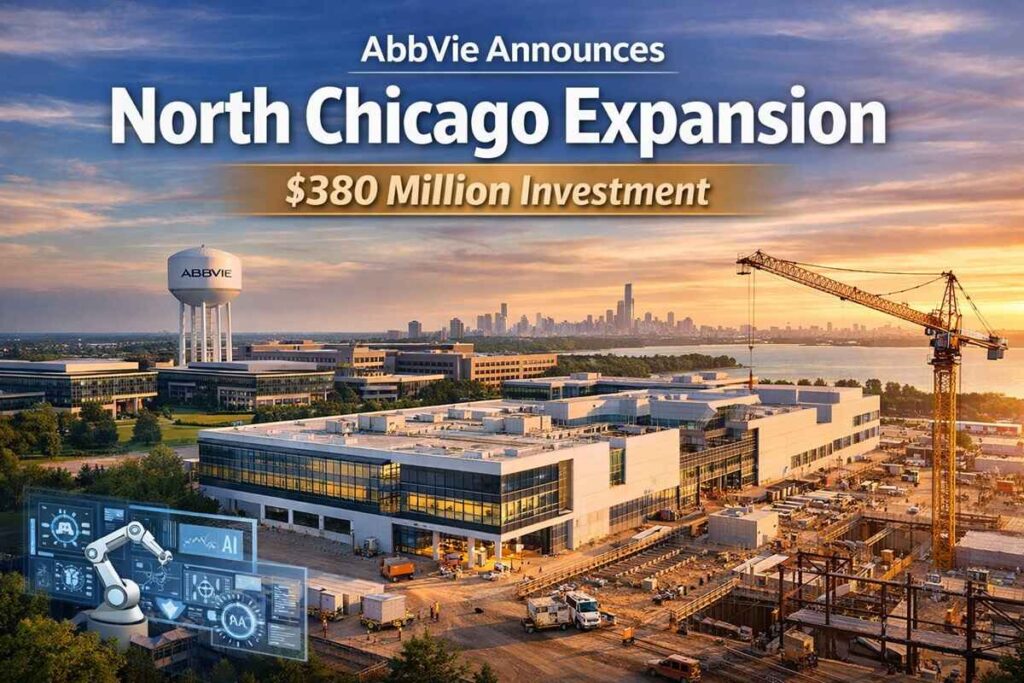
On Monday, February 23, 2026, AbbVie announced a major $380 million investment to build two new active pharmaceutical ingredient (API) manufacturing facilities at its North Chicago, Illinois headquarters.
This move is a direct response to a massive shift in U.S. trade policy—specifically a 100% tariff on branded pharmaceutical imports introduced in October 2025. By breaking ground on these facilities, AbbVie secures an exemption from these tariffs, which effectively double the cost of bringing foreign-made drugs into the country.
Project Blueprint: The Future of Biotech
The new facilities are designed to be “Smart Plants,” shifting production away from overseas hubs in Europe and Asia to a centralized domestic campus.
- Target Medications: Specifically built for next-generation neuroscience and obesity drugs (the latter being a high-growth sector AbbVie entered in 2025).
- AI Integration: The plants will be the first in AbbVie’s network to fully integrate Artificial Intelligence into the manufacturing process for real-time quality control and supply chain optimization.
- Timeline: Construction is set to begin in Spring 2026, with the facilities reaching full operational capacity in 2029.
- Job Creation: Expected to create 300 high-skill jobs, including roles for engineers, scientists, and AI-driven manufacturing operators.
Strategic Rationale: Reshoring & Resilience
This investment is part of AbbVie’s broader $100 billion decade-long commitment to U.S.-based R&D and manufacturing.
- Tariff Avoidance: The “Manufacture-in-U.S.” acceleration is a survival strategy for major pharma. Drugmakers like AstraZeneca, GSK, and Novartis are similarly rushing to break ground to avoid the 100% “Truth Social” tariffs.
- Obesity Market Entry: As competition heats up with Eli Lilly and Novo Nordisk, AbbVie is building the infrastructure to produce its new amylin analog (ABBV-295) and other weight-loss pipeline assets entirely on American soil.
- National Security: By reshoring API production—the most complex part of drug making—AbbVie is reducing its vulnerability to the global supply chain disruptions that have plagued the industry since the 2020s.
“By strengthening our U.S. manufacturing capabilities, we are well-positioned to support our investment in innovation and enhance our ability to deliver next-generation medicines to patients.” — Robert A. Michael, Chairman & CEO, AbbVie.
The “Pharma Reshoring” Wave (February 2026)
AbbVie isn’t alone. In just the last week, the U.S. has seen a surge in domestic manufacturing commitments:
- J&J: Announced a $1 billion cell-therapy investment in Pennsylvania.
- Eli Lilly: Expanding its Indiana “Lilly Technology Center” with another $2.5 billion.
- AstraZeneca: Broke ground on a new $300 million facility in Maryland.