
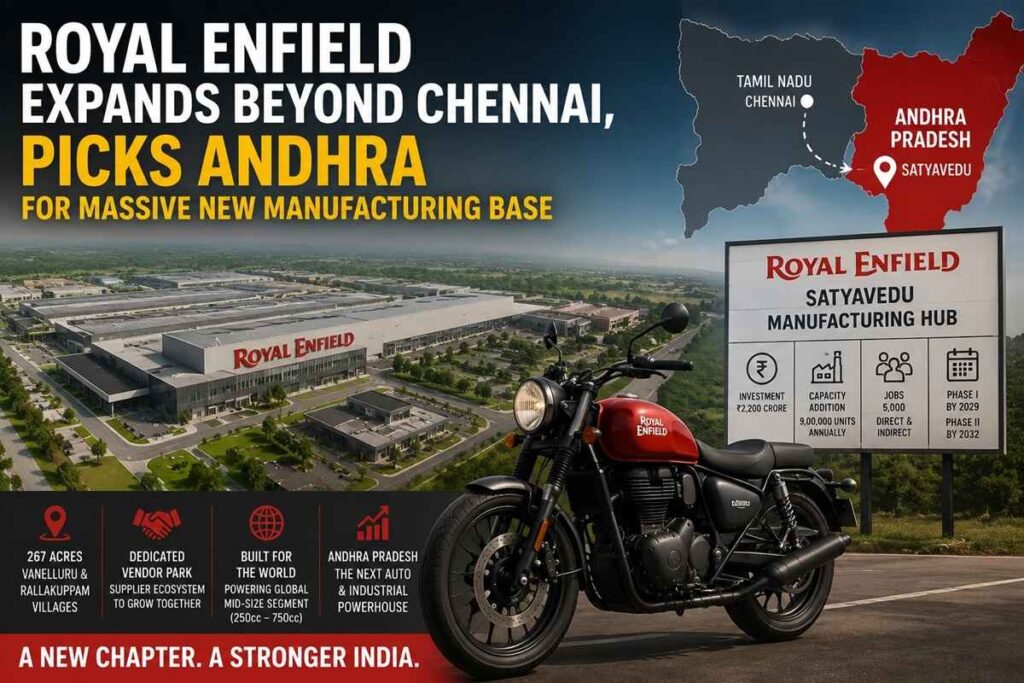

On Monday, May 18, 2026, Eicher Motors-backed Royal Enfield officially formalized its plans to branch out of its traditional base in Tamil Nadu, announcing a massive ₹2,500 crore greenfield manufacturing plant in Tada, Tirupati district, Andhra Pradesh.
This milestone announcement was followed by an endorsement from Andhra Pradesh Chief Minister N. Chandrababu Naidu, who revealed the state’s aggressive target to compress the project’s execution timeline from 24 months down to 18 months using the state’s “Speed of Doing Business” framework.
Project Blueprint: The Tada Integrated Megafab
The facility is being designed not just as an assembly line, but as a self-sustaining automotive ecosystem to support Royal Enfield’s next generation of mid-size motorcycles (250cc–750cc).
- Total Investment: Approximately ₹2,500 crore, to be deployed in a calibrated, phased manner subject to final board approval.
- Land Parcel: 215.7 acres strategically secured in the Tada industrial hub.
- Production Output: The plant will add a massive 900,000 (9 lakh) units annually once both phases are fully operational.
- Job Creation: Projected to generate 15,000 direct and indirect employment opportunities—a massive leap for the local region.
- Phased Roadmap:
- Phase I (Targeted for 2029): Focuses on setting up the main state-of-the-art manufacturing plant, an R&D center, a dedicated testing track, and a co-located vendor park for Tier-1 suppliers.
- Phase II (Targeted for 2032): Full scaling of high-volume manufacturing lines and export log-bases.
The Capacity Pinch: Why Tada is Critical
The decision to pull the trigger on a fresh greenfield site stems from severe capacity constraints back home in Tamil Nadu:
- Peak Utilization: Royal Enfield’s existing capacity of 14.6 lakh motorcycles per year is running at near 100% capacity utilization, driven by successive record-breaking fiscal years. (In FY26, the brand crossed 1.23 million global sales).
- The Cheyyar Buffer: The ₹958 crore expansion at its Cheyyar plant (announced in February 2026) is currently underway to push total Tamil Nadu capacity to 20 lakh (2 million) units.
- Future-Proofing Beyond 2 Million: The Tada facility serves as the strategic growth cushion beyond the 20-lakh barrier, allowing the brand to avoid prolonged waiting periods for popular domestic variants and seamlessly support its expanding global portfolio.
Strategic Rationale: Risk Diversification & Export Readiness
For decades, Royal Enfield has relied entirely on its a triad of plants in Tamil Nadu (Tiruvottiyur, Oragadam, Vallam Vadagal, and Cheyyar).
- Geographical Risk Mitigating: Establishing a base in Tada allows the brand to hedge its bets across a second state while remaining functionally close—just about 70-80 kilometers—to Chennai’s deep-water ports and its core engineering technical center.
- Global Clout: Royal Enfield was recently rated the world’s 3rd strongest auto brand by the Brand Finance Automotive Industry 2026 report. Tada will act as a primary manufacturing feeder for both domestic markets and its seven international CKD (Completely Knocked Down) assembly facilities in Brazil, Thailand, Argentina, Colombia, Nepal, and Bangladesh.
- EV Readiness: While primarily geared for mid-size combustion engines, the greenfield layout gives the brand the space to establish dedicated assembly lanes for its upcoming electric motorcycle pipeline when consumer adoption scales up.
“We currently operate four world-class manufacturing facilities in Tamil Nadu, with a total projected capacity of 2 million units annually. This investment in Andhra Pradesh will augment that capacity and provide the impetus for our next phase of growth.” — B. Govindarajan, MD of Eicher Motors & CEO of Royal Enfield.
Disclaimer:
The information provided on this website is intended solely for general informational and educational purposes. Certain content may be generated using artificial intelligence and could contain inaccuracies or omissions; therefore, its accuracy, completeness, and reliability cannot be guaranteed. Any opinions or views expressed are those of the respective authors or sources and do not necessarily represent the official editorial position of this publication.
