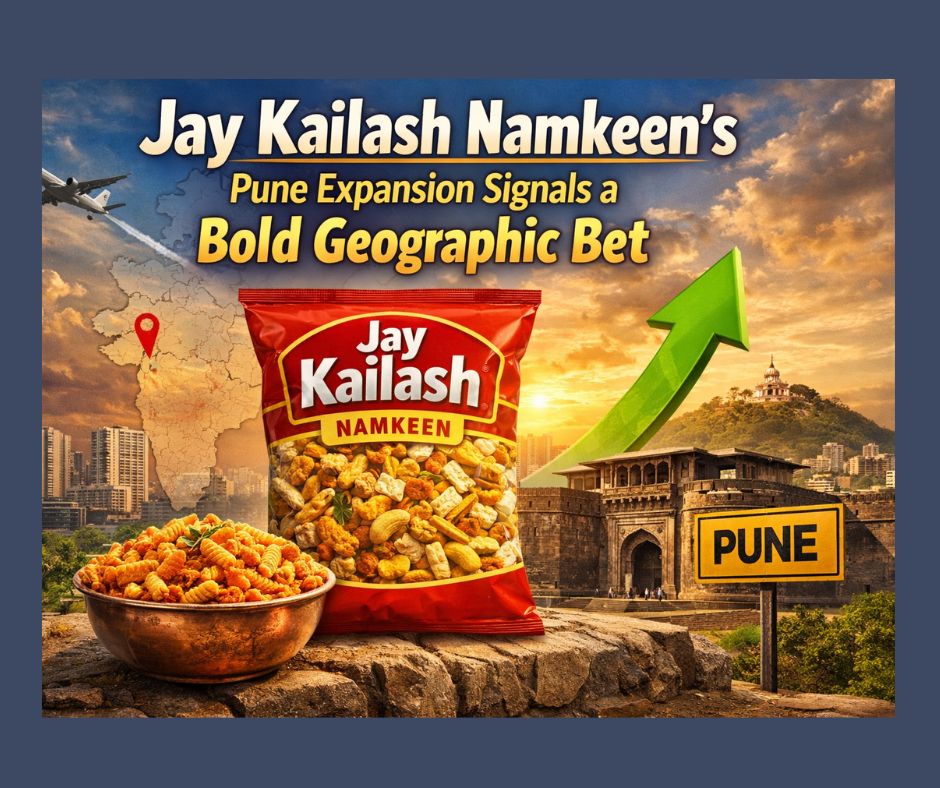

In a sector where regional loyalty is often the strongest barrier to entry Jay Kailash Namkeen Limited is making a bold play to transform from a Gujarat-centric brand into a multi-state contender. The company recently finalized an 8-year lease agreement for a new 20,000-square-foot manufacturing facility in Pune, Maharashtra.
This move marks a pivot in the company’s history, establishing its first major production footprint outside its traditional base in Rajkot. With a monthly lease of ₹1.32 lakh, the investment is a lean but strategic entry into one of India’s most competitive snacking markets.
The Strategy: Why Pune, Why Now?
Expansion in the FMCG (Fast-Moving Consumer Goods) sector is rarely just about building more capacity; it’s about logistics and local palates.
- The Logistics Moat: Namkeen products are low-value but high-volume. Transporting them from Rajkot to Maharashtra adds significant “freight drag” to margins. By producing in Dhayari, Pune, Jay Kailash cuts its “farm-to-shelf” time for the lucrative Western Maharashtra market.
- The “Maharashtra Flavor” Gateway: Pune and Mumbai have a distinct snack culture. Local production allows the brand to potentially tweak its 186 SKUs (Stock Keeping Units) to better suit the Maharashtrian preference for Misal bases and Chivdas, moving beyond its core Chana Jor and Soya Stick dominance.
- B2B to B2C Evolution: Having recently pivoted from a bulk B2B supplier to a consumer-facing brand, Jay Kailash needs physical proximity to its new distributors and retailers to ensure product freshness—a key metric for consumer trust.
Analysis: Navigating a “Crunch Point” in the Market
The timing of this expansion is intriguing. According to 2025 industry reports, the Indian namkeen market is currently at an inflection point. While the market is projected to grow at a CAGR of 8.6%, volume growth has slowed as consumers shift toward “clean label” and “premiumized” snacks.
| Metric | Details | Strategic Value |
| Facility Size | 20,000 Sq. Ft. | Provides scale for high-volume automated lines. |
| Lease Tenure | 8 Years | Signals long-term commitment to the Maharashtra market. |
| Location | Nanded Phata, Pune | Strategic access to both Pune city and the NH4 highway. |
| Funding | Internal Growth Strategy | Moving toward a leaner, decentralized manufacturing model. |
By securing a 20,000-square-foot unit, Jay Kailash is positioning itself to handle high-throughput automation. Industry data suggests that automated production lines can increase output efficiency by up to 30%, a necessity when competing with giants like Balaji or Haldiram’s.
Regulatory & Investor Perspective
The deal is a “clean” transaction—conducted at arm’s length with no related-party interests—which is a positive signal for corporate governance in the SME segment.
However, investors will be watching closely to see if the company can reverse its recent stock performance. Despite a successful debut on the BSE SME platform, the stock has faced headwinds in 2025. The success of the Pune unit will be a litmus test for the company’s ability to scale operations without diluting its margins.

