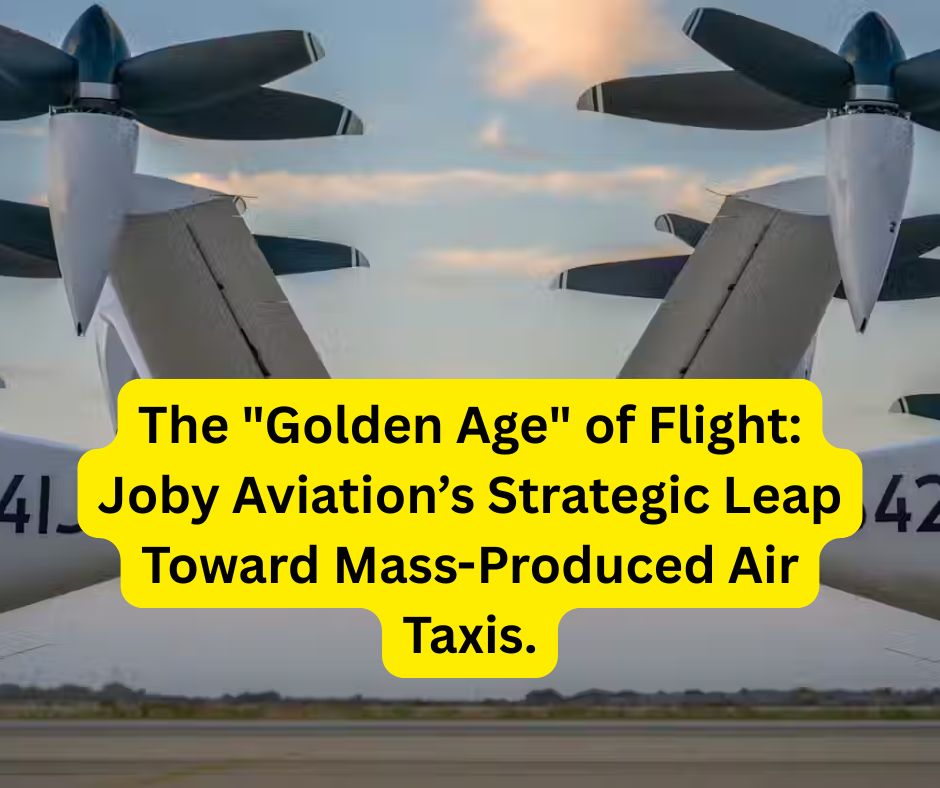

The announcement from Joby Aviation that it will double its U.S. manufacturing capacity to four aircraft per month by 2027 is a watershed moment for urban air mobility. While “four aircraft a month” might sound modest compared to automotive giants, in the world of high-stakes aerospace certification, it represents the industry’s first serious transition from “experimental” to “industrial.”
This move, supported by a significant manufacturing alliance with Toyota signals that the era of the electric air taxi has moved past the drawing board and into the factory.
Why This News Matters: The Industrialization of eVTOL
The electric Vertical Take-Off and Landing (eVTOL) sector has long been criticized for “paper planes”—lofty promises with little hardware to show. Joby’s expansion changes that narrative in three ways:
- Scaling Beyond the Prototype: By procuring capital equipment and hiring for round-the-clock operations in California and Ohio, Joby is building the infrastructure of a legitimate aerospace OEM (Original Equipment Manufacturer).
- The Toyota Factor: Developing a revolutionary aircraft is one thing; building it reliably at scale is another. Leveraging Toyota’s “Lean Manufacturing” expertise is Joby’s secret weapon to avoid the production bottlenecks that often sink hardware startups.
- Governmental Tailwind: The mention of the U.S. government’s eVTOL Integration Pilot Program and a Presidential Executive Order shows that federal regulators are no longer just “allowing” this tech—they are actively clearing the flight path to ensure American leadership in the next aviation era.
Expert Insights: The Race for Certification and Capacity
From a senior generalist’s perspective, the “four aircraft per month” target is a carefully calculated figure.
- Conforming to Standards: Joby is currently in the Type Inspection Authorization (TIA) stage—the final “boss fight” of FAA certification. These conforming aircraft are not prototypes; they are the exact models that will be used for commercial flight. Producing them at a steady clip allows for simultaneous testing and fleet building.
- Market Readiness vs. Overproduction: By 2027, Joby aims for a production rate that satisfies early commercial demand without over-leveraging their balance sheet before the market fully matures.
- Vertical Integration: Unlike many competitors who outsource components, Joby’s Ohio facility is producing its own propeller blades. This reduces supply chain risk and ensures that every flight-critical component meets their specific noise and safety profiles.
Future Implications: What to Expect in 2026 and Beyond
The ripple effects of this investment will be felt across urban infrastructure and the broader transportation market:
- Commercial Launch in 2026: The news confirms that Joby is positioning itself to carry its first paying passengers as early as 2026, likely in “early-adopter” markets like New York, Los Angeles, or Dubai.
- Redefining the “Commute”: With over $1 billion in potential sales, the business model is shifting. We aren’t just looking at a luxury service; we are looking at the potential for air taxis to become a high-speed “feeder” for traditional airports and transit hubs.
- The Regulatory Blueprint: The FAA’s willingness to enable operations ahead of full certification via the Integration Pilot Program sets a global precedent. It suggests a more agile, data-driven approach to aviation safety that could benefit other emerging technologies like autonomous flight.
The Bottom Line
Joby Aviation is no longer just a “tech startup”; it is becoming an industrial power. By doubling down on manufacturing and tightening its bond with Toyota, the company is betting that the infrastructure of 2027 will be ready for a fleet of quiet, electric taxis that can turn a two-hour traffic jam into a ten-minute flight.
